
September 25, 2026 · Rick Kennerknecht
What Hardcore Elk Hunter Gets Right About September
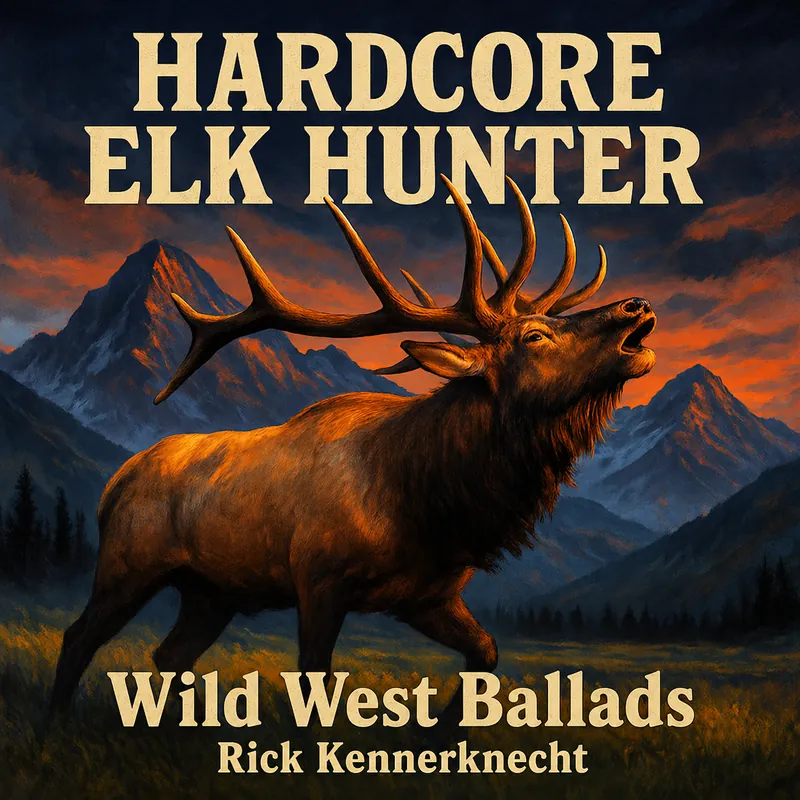
There is a moment in the third week of September, somewhere above nine thousand feet, when a bull answers one ridge over and everything in you goes quiet. If you know that moment, this song is already about you. If you have never had it, three and a half minutes is the closest I can get you.
"Hardcore Elk Hunter" is the only hunting song in a catalog of sixty-three ballads, and the only one where the man in it is still alive. Everything else on this site is about somebody a century or more dead. So before anything else, here is whether it gets the season right.
What the song gets right, which is most of it
I check the historical songs against the archives, and when a lyric and the record disagree I say so on the fact checks page. It seemed only fair to check this one against the practice.
The scouting season is correct. Verse two has him running trails from July through August, marking wallows and rub lines. That is the actual work, and it is the part nobody films. What most people picture as elk hunting is the last two weeks of a job that started in midsummer.
September is the right month, for the right reason. The chorus is built on it. According to the National Park Service at Rocky Mountain, the peak of the rut runs from mid-September into mid-October, with bugling sometimes carrying into November. That is why the man in the song lives for September rather than for opening day. He is not waiting on a date. He is waiting on the animals.
The bugle is an argument, not a noise. The Park Service describes what the bull is actually doing with it: announcing he has a harem, telling cows that have drifted too far to come back, and warning other bulls that he is willing and able to defend what is his. The song calls it "a promise at timberline's gate," which is closer to the biology than it probably meant to be.
The gear and the misery are right. Horses packing deep through the pines, panniers coming out loaded, coffee by lantern, a canvas wall tent with a woodstove. And the line I like best in the bridge, "Heartbreak and pack-outs, every mile I roam." Anyone who has carried a quarter of an elk down a mountain in the dark knows exactly why those two words belong in the same breath.
The three-year bull is the truest thing in it. "Got a bull in my dreams I've chased three years straight." That is not a lyric reaching for drama. That is just how it goes.
If you want this year's dates rather than the biology, those come from Colorado Parks and Wildlife and they move every season, so I am not going to print them here and have them be wrong by next autumn.
The line the whole thing turns on
The outro gives the game away.
If I tag him or miss him, Lord knows I've been blessed. It's the chase and the silence that give me my rest.
That is the reason there is a song here at all. A ballad about killing an elk would be a short and fairly stupid piece of music. This one is about going back every year to a place that owes you nothing, and counting it a good season either way. The elk is the excuse.
Why an elk song sits in a catalog of outlaws
The short answer is that I live in Fruita, Colorado, and the West did not stop in 1881.
The longer answer is that I kept writing about people who went up into these mountains to do something hard, and at some point it seemed strange that every one of them had to be dead to qualify. The man in this song rides country Bass Reeves would have recognized. He is just doing it with a bow and a wall tent instead of a warrant.
In the catalog's own filing system he is the only one of his kind. Thirty-two ballads carry the wild-west tag, seventeen are outlaws, fourteen belong to the Tombstone saga, fourteen to the women of the West. Exactly one is tagged hunting.
Its nearest cousins are the other songs about the West as it is now rather than as it was. Old Dogs & Old Trucks is about two things that rattle and neither one quits. Goin' Once is an auctioneer's chant rolling across a stockyard. This is Norco is a horse town that refused to pave itself.
And if you want the other direction, the road runs back a century and change to Calamity Jane, who nobody could ever pin down, and Anne Bonny, who fought like a man and then walked out of the record entirely.
Listen
"Hardcore Elk Hunter" is on its song page with the streaming links, and the whole catalog is free to play on the listen page.
It was written in F major at 71 beats a minute, slow enough to walk to. That was not an accident. Most of elk hunting is walking.