
September 8, 2026 · Rick Kennerknecht
Anne Bonny: The True Story Behind "Fought Like a Man"
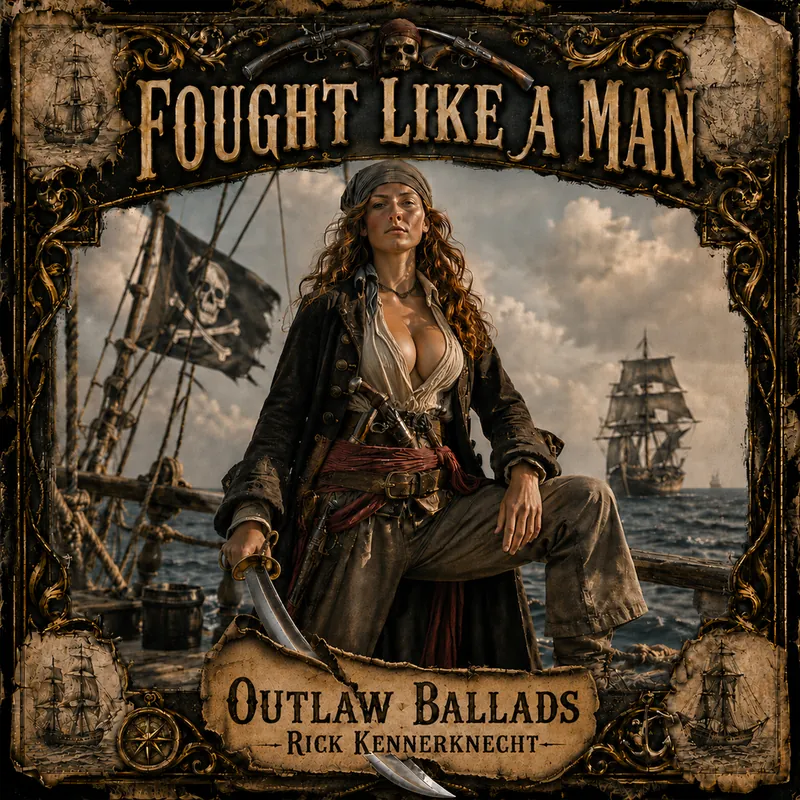
In October 1720, off Point Negril on the north shore of Jamaica, a privateer named Jonathan Barnet ran down a stolen sloop called the William. What the boarding party found on deck has been retold for three hundred years, and this time the telling is close to the record: most of the crew was below, too drunk on rum to fight. Two people stood on the open deck and defended the ship. Both of them were women.
One was Mary Read. The other was Anne Bonny, and she is the reason I wrote "Fought Like a Man".
What the record actually says
Almost everything the world thinks it knows about Anne Bonny comes from one book, and the book is not a court document.
The reliable material is thin. In November 1720 at Spanish Town, Jamaica, Anne Bonny and Mary Read were tried and condemned. That testimony is the only eyewitness description of Anne Bonny that exists.
What did Anne Bonny look like?
Witnesses said she wore a man's jacket and long trousers, with a handkerchief tied around her head, a machete in one hand and a pistol in the other. That is the whole physical record of her. Every painting and engraving you have ever seen was made by somebody who never laid eyes on her.
There is no red hair in any period source. No height, no eye colour, no description of her face, only what she was wearing and what she was holding on the day she was taken. The redhead everyone pictures is modern folklore, stuck to her so firmly that most people assume it is documented.
What happened to Calico Jack Rackham
Her captain, John "Calico Jack" Rackham, was hanged at Port Royal on 18 November 1720, his body left hanging in chains on a cay in the harbor as a warning. Bonny and Read were tried separately and both condemned, and both then "pleaded their bellies," meaning they declared themselves pregnant, which under English law stayed an execution. The claim was tested by an all-female jury of matrons, whose finding the court did not dispute. Mary Read died in the Jamaica gaol the following April, most likely of fever.
And that is where the documents stop.
What comes from one book
The rest of the story, the part everybody knows, comes from *A General History of the Pyrates*, published in London in 1724 under the name Captain Charles Johnson, four years after the trial. That one book did more than any other to fix the popular picture of the golden age of piracy, and almost every pirate story told since has been drawing on it. That is where we get Ireland: born in County Cork around the turn of the century, the illegitimate daughter of a lawyer named William Cormac, the scandal that pushed the family across the Atlantic. That is where we get Charles Town, where Cormac prospered as a merchant and a rice planter and raised his daughter for drawing rooms and a good marriage. That is where we get James Bonny, the small-time pirate she married and left, who later turned informer for the governor of the Bahamas.
None of it is impossible. Some of it is probably true. But it is one author, writing for a paying audience, four years after the fact, and no historian treats it the way they treat the trial transcript. Vivian Walman-Randall sets the two sources side by side in "Real and Imagined: The Lives of Anne Bonny and Mary Read", free to read, and worth the hour.
I mention all this because I think the honest version is more interesting than the tidy one, and because it explains why the song is built the way it is.
The line the song is named for
The most famous thing Anne Bonny is supposed to have said is what she told Rackham on the morning he was hanged, when he was allowed to see her one last time: that if he had fought like a man, he need not have been hanged like a dog.
It is a magnificent line, and it is attributed. It appears in Johnson's book. It is not in the trial transcript. I put it in the song because it belongs to her the way a folk song belongs to whoever has sung it longest, but I won't tell you a clerk in Spanish Town wrote it down, because none did.
That one attributed sentence is the whole spine of the record. Everything in it is her: the contempt, the loyalty that had already curdled, the refusal to soften it on the last morning of a man's life. She is not grieving in that line. She is grading him.
Anne Bonny's death: the blank page
Then Anne Bonny disappears.
No execution recorded. No release. No grave. There is no recorded date of death for Anne Bonny, and no account of her death written by anybody who was there. After the spring of 1721 she is simply not in the paperwork again, and 300 years of writers have filled that silence with whatever they needed: a rich father buying her out, a quiet life under another name, a death nobody wrote down.
I did not pick one. The song ends where the record ends:
Then the record just runs empty — no gallows and no grave / Anne Bonny slipped the story like a ship slips off a wave
That was the whole reason to write it. A song about a woman who won't be pinned down should not end by pinning her down. Where the record is silent, the song is silent.
Anne Bonny in Black Sails, Black Flag and the modern legend
If you came here after meeting Anne Bonny on a screen, it is worth saying plainly: the woman you met was invented, and you can check which parts.
Black Sails, the Starz series that ran from 2014 to 2017, cast Clara Paget as Anne Bonny across all four seasons and set her story years before the trial, in a plot that runs up to where Treasure Island begins. It is very good television. It is not evidence, and almost everything her character does there happens in years the documents say nothing about at all.
Assassin's Creed IV: Black Flag put her in Edward Kenway's crew in 2013, and Ubisoft's remake, Black Flag Resynced, brought her back on 9 July 2026, which is a fair part of why people are asking about her again this year. Netflix's The Lost Pirate Kingdom is the documentary-drama version, and like every screen telling it leans on Johnson, because there is nothing else to lean on.
None of that is cheating. They are doing what Captain Johnson did in 1724, with better budgets: taking a woman who left one court record and about three months on the account, and building a whole person around the gap. Anne Bonny and Mary Read have been getting that treatment for three hundred years.
The only real difference is that Johnson got there first, and his version has had three centuries to harden into something people mistake for the record.
Writing it
"Fought Like a Man" is sung in first person, in her voice, and it is one of the songs in Pirate Country, a strand of the catalog that runs an outlaw-country backbone underneath Caribbean color. Steel drum and marimba against pedal steel should not work as well as it does. It is bright and driving rather than mournful, which was deliberate: this is not a lament. Defiance is the only emotion in it, start to finish. There is an official lyric video if you would rather read along.
The verses follow the actual sequence: Ireland to Carolina, Nassau and the sloop stolen out of the harbor at night, then the fight off Jamaica. The prizes they took were fishing boats and trading sloops, not treasure galleons, and the song doesn't inflate them.
A few things I left out on purpose. There is no red hair in the song, for the reason above. No eyepatches, no parrots, no treasure chests. And no invented death, because she doesn't get one.
As with everything here, the words are mine and the production is AI-assisted, which we explain in full rather than bury. Every track is plagiarism-checked before release.
Anne Bonny was on the account about three months. She took no treasure worth the name, commanded nothing, and left one court record, one attributed sentence, and a hole in the archive where the end of her life should be. Three hundred years later we are still talking about her, which suggests the men hiding below decks got the arithmetic exactly backwards.
More Pirate Country
She has company on this side of the catalog. Pardon Won't Hold is Jean Lafitte, who took the President's pardon at New Orleans and went straight back to the account. Rich Enough to Drown is Black Sam Bellamy, who took the Whydah and lost the lot to a Cape Cod storm. Run Out of Coast is Blackbeard at Ocracoke, with the inlet closing and Maynard's men coming over the rail.
Hear the whole catalog, or, if you have a story that deserves one, we write those too.