
September 28, 2026 · Rick Kennerknecht
Buffalo Bill Cody: The Family He Left on the Road
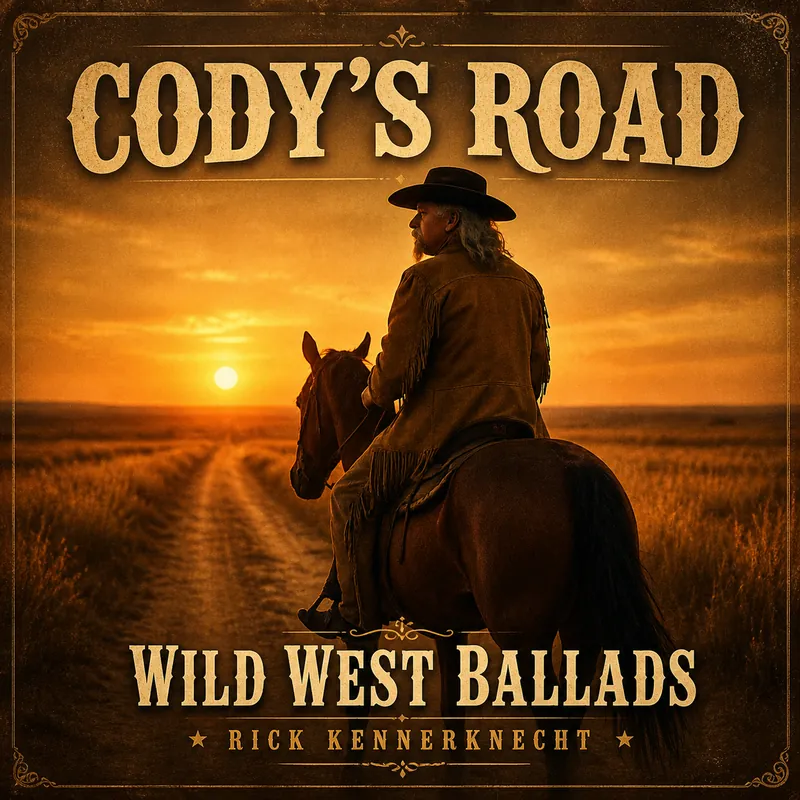
I have written three songs about Buffalo Bill Cody already. Just 18 During the Civil War is the boy riding the war's western edge. Ridin' for the Mail is the fourteen year old carrying mail across country that had already killed grown men. Medal for a Scout is the Medal of Honor he earned on the Platte and the Army took back thirty years later on a technicality.
Writing a fourth, I did not want another list of things the man accomplished. I wanted the part nobody puts on a poster.
He was on the road nearly all year, for decades. He crossed the Atlantic eight times with the show. And while he was out there being the most famous American alive, his wife was keeping a house in Nebraska, his children were growing up without him, and three of the four died before he did.
That is what "Cody's Road" is about.
Was Buffalo Bill a real person?
Yes, and it is worth clearing this up first, because a lot of people arrive at the name sideways.
William Frederick Cody was born in 1846 in Iowa and died in 1917. He really did scout for the Army, really did hunt buffalo for the railroad crews, really did earn the Medal of Honor, and really did build the biggest touring show on earth. Everything below happened to an actual man with an actual family.
The other Buffalo Bill, the killer in The Silence of the Lambs, is invented. Thomas Harris gave him that name through a detective's grim joke in the story, riffing on the Wild West show's old claim that Cody had scalped a Cheyenne warrior. The name travelled. The man it was taken from had been dead seventy years.
Who was Buffalo Bill Cody's wife?
Louisa Frederici. They married on 6 March 1866 at her family's place in Arnold, Missouri, and stayed married for fifty one years, until he died.
They settled at North Platte, Nebraska in 1878, and the pattern set in there and never really broke. Show business kept him away most of the year. Louisa ran the household. The two of them lived largely separate lives, connected by letters and railway timetables.
How many children did Buffalo Bill Cody have?
Four. Arta Lucille, born 1866. Kit Carson, born 1870. Orra Maude, born 1872. Irma Louise, born 1883.
Three of them died before their father did. Only Irma outlived him, and only by a year.
The night Kit died
This is the one I keep coming back to, and I did not know it when I wrote the song.
On 21 April 1876, Kit Carson Cody was five years old and dying of scarlet fever in Rochester, New York. Two of his sisters were sick with it in the same house. Louisa telegraphed.
Cody was on a stage in Springfield, Massachusetts. He finished the first act, walked off, and caught a train.
He made it. The boy died in his arms that night.
The Buffalo Bill Center of the West tells it in full, and it is a harder and better story than the one I put in my own verse.
Orra, 1883, and a line in my song that is wrong
Here is where I correct myself.
Verse two of "Cody's Road" says:
Orra's eyes closed far too young, / I was off in Europe when the church bell rung
Orra Maude died in 1883, at eleven years old. Cody's first trip to Europe was in May 1887, for the American Exhibition in London during Queen Victoria's Golden Jubilee.
He had never crossed the Atlantic when Orra died. The line is off by four years. The William F. Cody Archive is unambiguous about the touring dates: eight European tours in all, the first four between 1887 and 1892, the last four from 1902 to 1906.
I wrote that couplet from the shape of the story rather than from the record, and the shape was right while the detail was wrong. This site's whole argument is that we tell you what is documented and what is not, so I am not going to leave it sitting there and hope nobody checks.
Arta, 1904, and the absence I was reaching for
The one I wanted belongs to Arta, the eldest.
She died at Spokane in early February 1904. The Spokane papers carried it on the first and the second of the month. Buffalo Bill's Wild West was in the middle of its 1902 to 1904 tour of Britain at the time, working its way through Scotland, Wales, Cornwall and the English provinces.
I could not find a source that puts Cody personally in Britain in that particular week, so I will not claim it flatly. But the show was an ocean away from Spokane, and that is the situation verse two was groping for. Wrong daughter, wrong decade, right feeling.
Why did Buffalo Bill file for divorce?
In 1904, after thirty eight years of marriage, Cody sued Louisa for divorce.
The allegations were ugly. He claimed she had tried to poison him on more than one occasion, which was later proved false. He also claimed she had made living at North Platte unbearable and intolerable for him and for his guests.
It came to trial in February 1905. The judge refused the divorce and held that incompatibility is not grounds for one. So they stayed married, and the only thing the case accomplished was to put his drinking and his women into every newspaper in the country alongside her name.
They reconciled in 1910. For the last stretch of his life Louisa often travelled with him. Fifty one years married, and the closest they came to a settled marriage was at the end of it.
The Irma Hotel
One line in the song I am glad holds up exactly. Cody opened the Irma Hotel in November 1902 and named it for his youngest daughter. It is still standing in Cody, Wyoming, still taking guests.
How did Buffalo Bill die, and where is he buried?
He died on 10 January 1917 at his sister's house in Denver, of kidney failure. He was seventy.
He is buried on Lookout Mountain above Golden, Colorado. Not in January, though. The winter roads up the mountain were impassable, so his body was held in cold storage and the funeral did not happen until June.
Cody, Wyoming has never entirely accepted it. An early draft of his will asked for burial on Cedar Mountain outside the town he founded, and a later will named Lookout Mountain instead. Out of that gap grew a hundred years of local conviction that Wyoming men swapped the body and took the real Cody home. The Denver Public Library has gone through the evidence and it does not hold up, but it is never going away either.
Even his grave is an argument. It suits him.
What has changed, and what has not
What struck me writing this is how little of it is really about 1876 or 1904.
Swap the Wild West show for a tour bus or a film set and it is the same story you read about famous people now. Gone most of the year. A marriage conducted at a distance. Children who grew up mostly without you. A very public falling out that neither party came out of well.
What has changed is the wire. When Kit was dying, a telegram found Cody in Springfield and a night train got him to Rochester in time. When the show was in Britain, news from home crossed an ocean by ship and by cable, and a father could be days or weeks behind his own family's worst mornings. Today he would have had a phone in his pocket and known inside the hour.
I am not sure that makes it any easier. It just makes it faster.
Writing the song
"Cody's Road" is sung in Cody's own voice, looking back. That was deliberate. Every other song I have written about him looks at him from outside, at the scout or the rider or the showman. This one is the man doing his own accounting, and the accounting does not come out in his favour.
The chorus is the whole argument:
I rode for the show, I rode for the name, / I rode for the glory, the fortune, the fame. / But in the quiet nights, my heart would know, / I left too much behind on Cody's road.
The bridge is the closest I let him get to saying it outright:
The crowds all cheered, the cannons roared, / But I dreamed of a family I ignored.
The lyrics are mine and were registered with the U.S. Copyright Office on 1 October 2025. The production is AI-assisted, which we disclose in full rather than bury, and every track is plagiarism-checked before release. You can hear it on YouTube if you would rather listen than read.
And no, I am not going back to re-record verse two. The record is the record, the song is the song, and this page is where the two of them get to disagree in public.
More from the Buffalo Bill album
Just 18 During the Civil War is Will Cody at eighteen, already scouting. Ridin' for the Mail is the boy on the mail route, keeping a schedule that had killed better riders. Medal for a Scout is the medal, and the paperwork that took it away.
If you want the same treatment of somebody who told even taller tales about herself, Calamity Jane is here.
Hear the whole catalog, or, if you have a story that deserves a song, we write those too.